Archive for the ‘Deeper Into Movies’ Category

10.27.2011

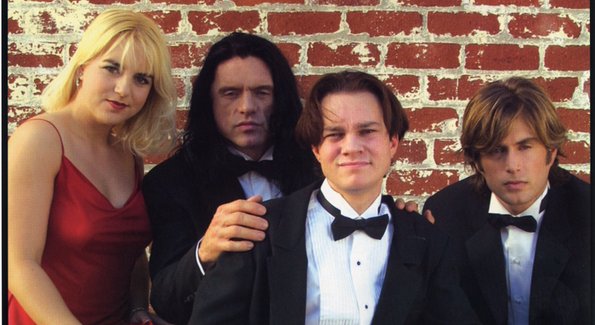
Deeper Into Movies: How ‘The Room’ is a Secret ‘Rebel Without a Cause’ Tribute

The Room
Wiseau Films

Since its 2003 release, Tommy Wiseau’s cinematic opus The Room has become our generation’s answer to the Rocky Horror Picture Show. Entertainment Weekly called it the “Citizen Kane of bad movies”; the inscrutable Wiseau, who starred, scripted, directed and produced the film, has been hailed as a “genius-savant” by Salon; there may yet be a national plastic shortage from the countless spoons thrown at midnight screenings across the country during audience-favorite lines such as “You are tearing me apart, Lisa!” But what if I told you that Wiseau’s cult car crash was in fact an elaborate tribute to an Oscar-nominated Hollywood landmark? Because it totally is! I happened to see 1955 classic Rebel Without a Cause at the Hollywood Forever Cemetery’s Cinespia screening recently, and, well, the facts don’t lie:

“You are tearing me apart, Lisa!” – Many writers and critics have noticed that The Room’s most celebrated line appears in Rebel Without a Cause’s first act, as Jim (James Dean) lashes out at his baffled parents (video). It’s even the same shot—close in on Dean, his hands raised and voice anguished. Without the “Lisa,” of course. But the comparisons don’t end there.
Read the rest of this entry »

9.18.2010

Deeper Into Movies: “Easy A” (2010)

In bullet points:

* This movie wants so badly to be really good! It makes pop culture references and notes movie cliches and tries to self-awarely transcend them (but does not). It clearly invokes Mean Girls and the John Hughes filmography (also films starring charming redheads) and, especially, Saved, and features a sharp-tongued, wiser-than-her-years heroine who you root for from the jump. Read the rest of this entry »

8.24.2010

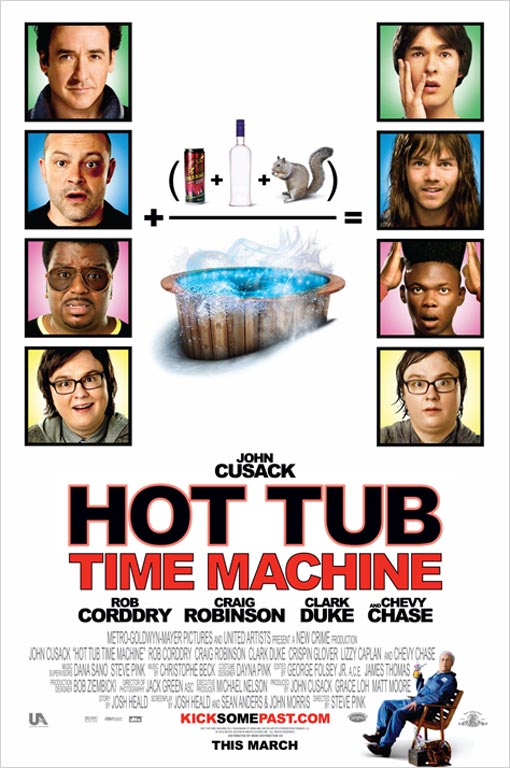
Deeper Into Movies: “Hot Tub Time Machine”

Ed. note: Somehow, this never made it out of draft and I’m too sick to write about indie rock. Enjoy.

As a child of the ‘80s and a now-20-something embroiled in the pop cultural nonsense of the ‘00s and ‘10s, Hot Tub Time Machine seemed as custom-made for me as a shit-covered Savile Row suit. On the one hand, it’s as big and broad and dumb a buddy comedy since The Hangover — poop, vomit, sperm and all manner of ejaculatory substances and blowjob jokes play prominent roles here — but on the other, it’s a spot-on homage to the comedic heritage of a bygone decade.

Hot Tub Time Machine, which, like Snakes on a Plane before it, embraces its high concept title with gusto, follows three middle-age burnouts and their tech-savvy nephew on a trip to the site of their youthful glory days, a ski lodge now a shadow of its former booze ‘n’ coke self. After they find a dead raccoon in the hot tub, the titular whirlpool invites them into its golden waters with inexplicable fanfare; like any great ‘80s movie, no one bothers to question the sudden turn of events before the quartet hop in and find themselves transported to 1986 in a strange marriage of Groundhog Day, Back To The Future and Weird Science.

The movie’s best jokes rely on transplanting modern references into the absurdity of the Reagan years, as when Rob Corddry drops a certain modern movie star’s name at a crucial moment during a coke-fueled bedroom romp, but it really is an homage to the era of Weird Science and Porky’s, full of cheesecake, concert scenes and a Crispin “Marty’s Dad” Glover running gag. It barely breathes without acknowledging meta elements, intentional (Glover, the ski lodge as a sideways reference to John Cusack’s ‘80s ski film, Better Off Dead) and not – Lizzy Kaplan, playing a young SPIN writer at the birth of hip-hop (OK, adorbs) is essentially a younger version of Cusack’s last on-screen love interest, 2012’s Amanda Peet. (Not to mention the heroine of show-of-the-millenium Party Down.) The film’s biggest problem is the issue of every clothing item in “1986″ coming directly from a 2010 Apparel Apparel rack, but the joke might be on us with that one.

The film’s all-star cast – John Cusack playing John Cusack, Rob Corddry playing Rob Corddry, Craig Robinson playing Darryl from The Office and Rawkblog hero Clark Duke playing the film’s shy straight man – is in fine form here, and when the group reaches their wish-fulfillment conclusion (an ending only the ‘80s could love), one can’t help but cheer. “We had AIDS and Reagan,” Cusack says at one point of the years he and his friends left behind, but cheer up, John – as Hot Tub Time Machine proves, you had so much more than that. Shia LaBeouf!

7.17.2010

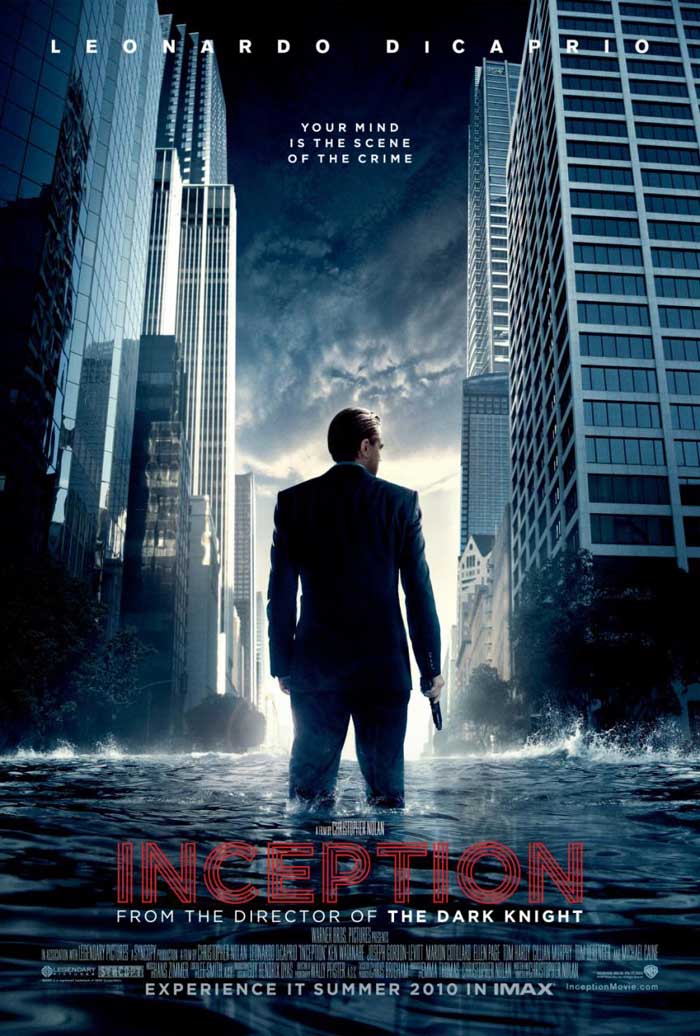
Deeper Into Movies: “Inception” (2010)

Inception is, in many ways, the anti-Matrix. Its protagonists are not reality-warping superheroes; it offers no tangled web of religious ideologies to make sense of. Its characters are not grappling with fate, but serving their own purposes.  And yet, it gives us worlds within worlds, real and unreal, dreams and waking life and what lies beneath both. In some ways, The Matrix is its better: Inception‘s action, a barrage of anonymous gunshots and punches, lacks the visual invention of the Wachowskis’ bullet-time or even the balletic choreography of the Bourne trilogy. But Inception, full of it as it may be, is not an action movie. It is a heist movie, a suspenseful one, and also a love story, set against the backdrop of complex hard science-fiction that requires one’s full mental energy. Inception is a thinking person’s summer blockbuster, if only because it requires you to pay attention: do so, and the dots will connect themselves.

The story tells itself better than I could, so I’ll spare you the details. But Inception, while not quite the masterwork of director Christopher Nolan’s The Dark Knight, finds the writer-creator delivering his most direct, emotionally resonant statement. In The Dark Knight and its directorial predecessor, The Prestige, the characters concluded the films by spitting out terse proclamations of their motives, gruffly outlining Nolan’s themes — not the screenwriter cardinal sin of talking the plot, but perhaps a worse one: unearthing the subtext. His reliance on such oral deliveries reappears here, but in Inception‘s world, the key lines are evocative, almost poetic — they feel revelatory instead of the opposite. This is largely the product of the love story, a complicated, beautifully visualized relationship that finds Leonardo DiCaprio’s troubled Cobb examining who, exactly, Marion Cottilard’s Mal is to him through the lens of his own subconscious.

In its third act, Inception stretches the suspense’s elasticity almost to the breaking point, but the film’s brilliant last shot is well worth the effort. The film makes necessary compromises: it builds a world (a half-dozen of them, really) without an origin story and lets it run wild, which leaves much of it still mysterious (though vastly more believable than anything from Lost). It is, for better (mostly, this) or worse, a Christopher Nolan movie, one both as visionary and limited as his imagination. One can only wonder if he dreams of electric sheep.

7.1.2010

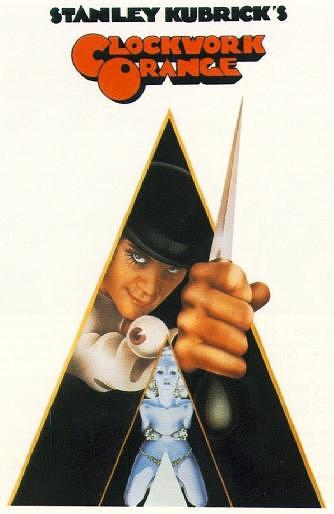
Deeper Into Movies: “A Clockwork Orange” (1971)

As previously noted, I’m making my way through the Stanley Kubrick filmography; the time has come for A Clockwork Orange. Some really good moments, though not quite the cinematic mind-blower that The Shining or 2001 was, visually or pacing-wise. It felt a little grungy and less deliberate, which is in keeping with the material, to be sure, and the shocking violence stands in for the visual expanse of a film such as 2001 — still, I missed seeing the limits of Kubrick’s imagination at play.

It’s meant to be an allegorical film, but I’m not sure exactly what it meant to accomplish with its moral: essentially, it places anarchy against fascism, with neither an acceptable option for Man, caught in the middle with his primal urges toward sex, violence, fear. The film seems to present alternatives twice in the form of the prison’s free will-embracing priest (who arguably merely offers another form of indoctrination) and in our anti-hero, Alex’s, single act of selfless goodness, when he gives spare change to the beggar in street. This act is rewarded, of course, with a beating followed by a near-drowning. Does Kubrick mean this to say people can’t change? Or the equally cynical view that while evil begets more evil, in an evil world, so does good? Read the rest of this entry »

5.11.2010

Deeper Into Movies: “Iron Man 2″

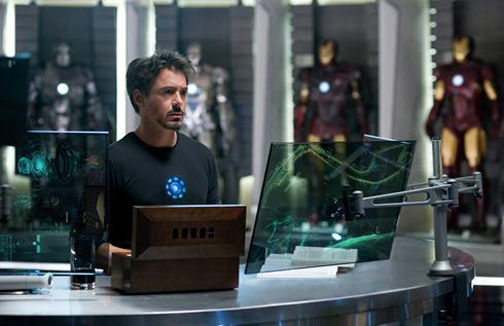
Iron Man 2For once, I’d like to put aside my critic’s cap and address this one as a fan. Iron Man 2 was fucking awesome. Worried by the raft of middling reviews (“Too much action! Too many villains! Too much everything!”), I waited until yesterday to see it; a mistake on par with picking Sarah Palin as a Veep candidate. Should’ve had more faith in Jon Favreau and Co., because there wasn’t a moment where I wasn’t completely pleased with what I was seeing on screen.

There’s more going on, yes, but the film kept the plot simple and linear, with Mickey Rourke’s Whiplash always clearly the main villain. The script was as sharp as one would want, with scattered laughs coming all the way through (Black Widow pepper-spraying a guard was a perfect sight gag) and Robert Downey Jr. still electric in the title role. I personally thought Iron Man could’ve done with more action; Iron Man 2 delivered. If it was too much for some, it bears remembering that this is a comic book movie and some of us would like to see things explode and robots punching each other. I thought it was better than Iron Man, believe or not, and am now trembling with tumescent glee at the thought of Thor. In short: Favreau for President.

(Jake astutely pointed out in the comments that an earlier draft of this post had a historically inaccurate analogy. Now, it does not.)

4.22.2010

Deeper Into Movies: “The Shining” (1980)

The Shining
Warner Bros.

The deeper I burrow myself into the Kubrick oeuvre, the harder it seems to look at the rest of film — the entire art form! — the same way again. The Shining might be the best movie I’ve ever seen; it’s certainly the most impressive experience I’ve had in front of a screen for 90+ minutes in at least two years. Some brief thoughts: Jesus Christ, the art direction! Shades of red (well, one purposeful shade: blood-red) permeate the film, from the hotel lobby’s pillars to Jack’s (Jack Nicholson) jacket. It’s aided, of course, by bone-white and coffin-brown. The cinematography: slow and deliberate, like a hovering ghost — always moving over your shoulder, wide-angled but not quite omniscient. One can see where Sam Raimi’s rush-camera shots for The Evil Dead, released just a year later, originated. The wide lenses turn the hotel’s long hallways and spacious rooms as claustrophobic as a janitor’s closet. The music: half the raw dread of dissonant strings and white noise, the other the scare-baiting of shrieks of doomed melody. And then the acting, my God: Jack Nicholson opens the movie with the kind of manic delight that makes you wonder if he’s just fucking with you (a style notably repurposed, particularly in the Spider-Man trilogy, by James Franco) and then, as he turns monstrous, makes you realize he’s not. Frame for frame, The Shining is on every level such a tour de force that it makes even the most labored-over competitor seem like an afternoon’s scribblings. All that, and scarier than hell.

Previously: Deeper Into Movies: Dr. Strangelove (1964)
More: Deeper Into Movies | Film + Television

4.15.2010

Deeper Into Movies: “Dr. Strangelove” (1964)

Dr. StrangeloveAs a relative newcomer to Stanley Kubrick (I’ve seen The Killers, Spartacus and bits of Full Metal Jacket), it’s hard not to be blown away by the directorial verve of Dr. Strangelove or: How I Learned To Stop Worrying and Love the Bomb. Released just two years after the Cuban Missile Crisis and one before Vietnam, the film filters Cold War paranoia through a series of thinly veiled comedy routines, making a mockery out of government incompetence and military short-sightedness. Shot in gorgeously contrasted black-and-white with the occasional wide-angle lens to add to the cartoonish humor of the proceedings, it’s an energetic cinematic effort even as it documents men in confined spaces (the multi-talented, multi-roled Peter Sellers, in particular), blustering in circles. Kubrick’s message — escalation never ends (and never thinks), even in the face of doomsday — was a bold one at the time, but in the still-fresh wake of eight years of the Bush administration, it’s no less audacious, or affecting, now.

More: Deeper Into Movies | Film + Television