Archive for the ‘Critical Backlash’ Category

2.13.2011

Critical Backlash: The ironic Dave Matthews Band revival has arrived

Above, Ezra Koenig, lead singer of critically acclaimed, chart-topping “indie rock band” Vampire Weekend, performing a purposefully amateurish version of Dave Matthews Band’s 1996 hit, “Crash Into Me.” For those who didn’t go to Jewish summer camp in the late ’90s, DMB (also referred to as “Dave,” as in, “Are you going to see Dave tonight? I’ll bring my hacky sack.”) merged folk-rock, jazz and traditional African influences into albums custom-designed to help college bros who could sort of play guitar get laid. That these albums, at least the ’90s ones, were actually awesome has long gone unnoticed among critics and hipster-types… until now. It’s 2011, 15 years since “Crash Into Me” was a hit, which is apparently long enough for it to undergo a Hall & Oates-esque cool-status turnaround.

Koenig’s cover’s a joke, but other imitators/homage-payers are more sincere: the chunky, horn-driven arrangements of Iron & Wine’s new album sound startlingly Dave-like at a times; L.A.’s Lord Huron plays long, uplifting jams impossible without serious hours logged listening to Under the Table and Dreaming; and even Deerhunter’s “He Would Have Laughed,” a tribute to late garage would-be icon Jay Reatard, evokes the central riff of the band’s “Satellite.” Listen closely, and you’ll hear the band’s influence in plenty of bands who wouldn’t be caught dead playing frat parties. Ironically or not, Dave Matthews Band’s cool-kid time has come: let me be the first to say I liked their earlier stuff better.

12.10.2010

Critical Backlash: Year-End Lists, ‘Best’ vs. ‘Favorite’ and the Perils of Consensus

A few truths I hold to be self-evident:

In defense of the word “Best”: The word “best,” when applied to art and specifically to year-end lists of pop albums, does not mean “Best of all the thousands of possible releases of the year.” It means “The best albums this particular critic was able to or chose to listen to this year.” Part of the job of being a critic, if you consider yourself one (and I do, and measure myself by that standard), is to decide what you will listen to, through what filters you will hear more and what you will avoid in the very limited time there is to listen to, absorb and pass judgment upon said releases. There will always be good albums and artists which fall through the cracks; however, if a critic does his or her job, frankly, there shouldn’t be that many. In other words: “Best,” coming from someone who gives a shit, ought to come pretty damn close.

In defense of “Best” over “Favorite”: Art contains both subjective and objective elements — some, of course, has more of one than the other. A singer’s timbre may be alternatively irritating or endearing depending on the listener. Within genre comparisons, one can approach objective judgments, but the inescapable — and necessary! — element of instinctual feeling and emotional reaction means, ultimately, no two people will ever agree on an all-encompassing hierarchy. In other words: There is no Platonic ideal for what makes a great song or a great album. (Except for maybe the Beach Boys’ “God Only Knows.”) This is what’s incredible about music: There are infinity ways to write and arrange and record and create it and an equally infinite amount of ways to enjoy it. My point here is that we as listeners create standards for what we enjoy based on culture, context, listening history, natural response, etc. Based on my personal standards — which are the only standards anyone can honestly have — the albums that I love the most are by default the ones I consider the best of the year. It would be nonsensical to classify them otherwise because there is no such thing as everyone’s best album of the year. Would you even want one? My favorites are my best.

Here’s where I think people get hung up: Read the rest of this entry »

11.11.2010

Critical Backlash: A PSA re: Seapony, twee and blog-fi

Here’s the funny thing: Seapony is a twee band. For all intents and purposes, they play the same music of Allo Darlin’ or Very Truly Yours or Pants Yell! or Pains of Being Pure at Heart or, to go all the way back, Tiger Trap and Go Sailor. A handful of open chords played always with that wonderful strumming pattern, a lead guitar playing melodic lines and a fey, winsome singer going on and on about some doomed/exciting romance. The beauty and danger of the genre is that doing it right requires a mold that doesn’t necessarily draw much attention to new bands outside its existing comfort-food fanbase, myself included. And yet! Seapony went through a pretty typical twee evolution, releasing a free EP, getting posted on places like Skatterbrain and Eardrums which care about this sort of thing (and on Rawkblog shortly after), but then the cool kids started paying attention. Gorilla Vs. Bear premiered their video. They’re on Pitchfork’s Forkcast. They’re all over Hype Machine. Here are some press quotes:

Seapony – “Dreaming.” Fitting in so well with this Best Coast-y, 60′s lo-fi surf music era we’re in right now…

Seapony makes the same type of angular beach indie that’s been at the bleeding edge of music…

EXCEPT THAT THEY DON’T! But it’s easy to see why the mistake’s been made: lo-fi. The band’s songs and performances are no different (and, while good, generally less memorable) than their oft-ignored peers, but like Pains of Being Pure at Heart, they chose to play with a thick layer of distortion (not, crucially, the genre’s typical jangle) amid the soft-focus reverb favored by garage-pop revivalists from Tennis to early Best Coast. Personally, I hate this sound: Production is a tool just like any other, and unless it adds some new/great flavor to your music, it’s a wasteful one — except as a cynical, careerist means of getting yourself written about on blogs that favor it.

Best Coast, it should be noted, has transcended her roots and made a medium-fi grunge record; there is nothing particularly lo-fi or garage-y or surf-y or mock-girl-group about it. It’s a Hole album. “Boyfriend” sounds like “Malibu.” And that’s awesome!

However, for bands like Tennis (or the Vivian Girls before them), who write nice but insubstantial songs, all that matters is the presence of signifiers: “Girl-group,” “’50s,” “garage.” This is generally enough for blogosphere/Fader/P4k buzz, quality be damned; but these influences, as en vogue as they may be, have very little to do with Seapony or 2010 twee, despite the band’s insistence on a trendy sonic wardrobe. This may not be true for long: the thin walls between underground pop genres, though, seem to be breaking apart, distressed by the endless onslaught of shitty-sounding guitar amps. Let’s evacuate the building.

10.25.2010

Deep Thoughts on the 2010 Bands You Can Ignore List

This list was intended to do a handful of things. Those things after the jump. Read the rest of this entry »

8.12.2010

Critical Backlash: Arcade Fire vs. Wavves vs. The Charts

Here’s what the Arcade Fire’s chart-topping 156,000 in first-week sales tells us:

I think it’s logical to make a correlation between obscurity of taste and volume of music piracy; in 2003 or so, I would’ve made a link to intelligence/nerdiness as well, but those days are over. Which is not to say that indie kids don’t buy albums, but here’s the thing: record sales, at least on the chart level, tell us about the mainstream. The Arcade Fire, more so than any quote-unquote indie band of the last half-decade, resonate with that mainstream. When Funeral came out, they got what turned out to be the most important Pitchfork review of all time and regular airplay on KROQ. That was unprecedented. They’ve only gone upwards in popularity from there.

By contrast, look at the sales for Wavves. Or Ariel Pink. Or any number of weirdo noiseniks who received the same level of blog buzz and P4k propulsion. The Arcade Fire, whatever one might think of them, write accessible rock anthems; so do most of the indie bands who’ve really crossed over. (Or dance anthems, etc.) The majority of people still interested in paying for music (or who don’t know any better, frankly) want something that speaks simply and broadly on at least one level to them, even if it speaks to the underground in more difficult, innovative ways. (Or even if it doesn’t, as in the case of the just-pretty-good Suburbs.)

My point here is that it all matters: touring (mostly, this), marketing, radio, videos, blog buzz, social networking, Amazon $3.99 sales (also, seriously, this — make every album $4 all the time and I guarantee profits would go up across the board), word of mouth and, of course, the music itself. Us writers would do well to remember the limits of our influence as we gluttonously beg for concert tickets and vinyl promos and claim we can lead a horse to water and make it drink. (Cross-posted from RawkTumblr)

6.10.2010

Discussion: Why Are We Scared To Like Paramore?

On Wednesday, Tom Breihan described Paramore as being “arguably the best of the MySpace emo wave, for whatever that’s worth” – a sentence as defensive as an abused puppy flinching at the touch of a shelter worker. (Weirdly, within hours of name-dropping the Get Up Kids.) It’s 2010, guys: we’re all listening to dance music our middle school selves would’ve called “super gay.” Why are we so afraid to listen to, much less enjoy, Paramore? Look: here’s an album stream. Pop open a new tab, put it on and listen. Is “Misguided Ghosts” really so much less evocative than Bon Iver? Isn’t “Careful” just a couple of haircuts and a guitar pedal away from Metric? Let’s talk this out in the comments. Read the rest of this entry »

5.17.2010

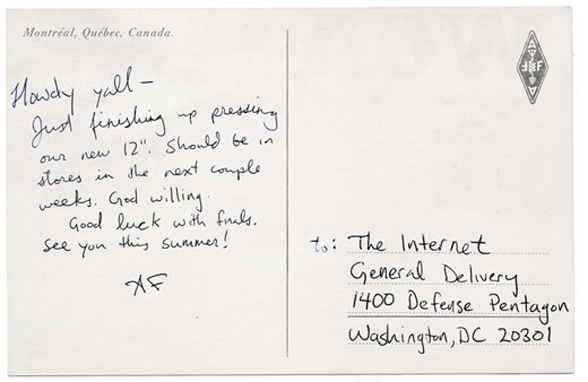
Critical Backlash: On The Arcade Fire, “In Rainbows” & The Viral Mistake

Arcade Fire Postcard

The nerdier among us (which, OK, hand raised) may remember the months and years of waiting for The Dark Knight — and the viral campaign which helped fill the lonely hours at home, alone, laptop a-glow, wondering what Heath Ledger would look like as the Joker. It was worthwhile for a number of reasons: the gestation time of films is long enough for Octomom to pump out another litter; the mystery dovetailed perfectly with Batman’s own role as the world’s greatest detective, and its intelligence only (deservedly!) increased confidence in the prospects of the film itself.

Applying these same smoke screens to music, however, has been less effective. Read the rest of this entry »

5.4.2010

Is This Video The Future Of Music Criticism?

Or is it just really endearing? Comments are open, you tell me. Wish dude has chosen a song for this that didn’t sound like a Sister Hazel b-side, though.